class | |||||||||||||||
| |||||||||||||||
| |||||||||||||||
property | |||||||||||||||
|
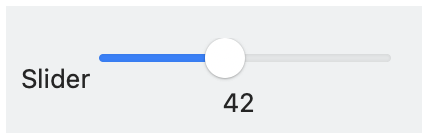
The ~value argument sets the slider’s initial or current value, with ~min_value and ~max_value determined the allowed range (inclusive) of the value.
The function call action(now_val) is performed when the slider is changed by the user, where now_val indicates the value of the slider.
The Slider.at_value property returns an observable that is updated whenever the slider’s value changes through an action (as also reported via action) or via value as an observable.
The style list must include one of #'horiziontal and #'vertical.
See Geometry Management for information about ~margin, ~min_size, and ~stretch.
The ~window_callbacks argument configures callbacks that are common to all WindowChildViews. See WindowCallbacks for more information.
enumeration | ||||||
|
#'horizontal: Creates a horizontal slider, where #'vertical and #'horizontal are mutually exclusive.
#'vertical: Creates a vertical slider.
#'plain: Creates an unadorned slider where the slider’s numerical value is not reported to the user.
#'horizontal_label: When the slider has a label, show it to the left of the slider. Horizontal label placement is the default if #'vertical_label is not specified, and #'horizontal_label and #'vertical_label are mutually exclusive.
#'vertical_label: When the slider has a label, show it above the control.